Showing posts with label Pinoy Technology. Show all posts

PlayStation 4 now sold in Philippines


MANILA – The much awaited PlayStation 4 gaming console is now available in the Philippines through the gaming and multimedia store chain DataBlitz.

In a post on its Facebook page on Friday, DataBlitz announced that it is now selling the PlayStation 4 for P24,595.

The gaming console may also be bundled with a PlayStation camera or with the “Killzone Shadow Fall” game, with each package priced at P26,595.

“Greatness comes with the number ‘4’! The PlayStation 4 will be available today at DataBlitz!” DataBlitz said as it uploaded photos of the console on its Facebook page.

“Release of the item may vary in different branches depending on their location and schedule of delivery,” it added.

Sony Philippines recently revealed its pre-order page for the PlayStation 4 ahead of its formal launch in the country on January 14, 2014.

Here, the PlayStation 4 console is priced at P24,999, and P26,999 with the camera. Sony Philippines also offers bundles with the “Killzone Shadow Fall” game (P26,899) and “Battlefield” (P27,399).
Pre-orders may be made until January 10 at selected Sony Philippines stores.

NASA To Announce “Earth-Shaking” Information On October 6?


NASA has allegedly launched a new website rememberthe13th.com, claiming to make a "historic, earth-shaking discovery" on November 13.

The wait is now shortened; now the announcement will be made on October 6, and the website has featured a countdown.

People have begun discussing the event in various forums, such as reddit.com, and some have come up with speculations of the reveal of fining life on Mars, predictions of powerful solar flares connected to the power blackout in November, another rapture, among others.


But what most people have found interesting though is how NASA is able to make announcements despite the current government shutdown. The official NASA website is shut down as of the moment, and will remain so until further notice.


Several redditors have even tracked the source of the announcement to a website registered in Panama, some users wondering how the website is a ".com instead of a .gov."

NASA itself is unavailable for comment or confirmation about having a direct connection to the website, being incapacitated by the recent United States government shutdown.

The rememberthe13th website is linked to various social media accounts, and encourages onlookers to sign up to release updates. Many netizens have reported to only receiving spam mails and ads upon sign-up.

The so-called announcement is reminiscent of last year's 3-week long wait for another supposedly "groundbreaking" announcement regarding the findings of the Mars Rover, but has been debunked, forums now dismissing the past event as caused by "another excited scientist."

Whatever the rememberthe13th.com website must be keeping everybody hanging about has since been cause for many to have a little fun. A spoof website, rememberthe14th.com, has been erected as example to how easily such an announcement could be made, anticipating the overhyped "reveal" with only good humor.

Source: Jobs & Hire

Yahoo! settles copyright lawsuit with Singapore news publisher


SINGAPORE — US Internet giant Yahoo! has settled a two-year lawsuit filed by Asian media group Singapore Press Holdings (SPH) over the reproduction of its news content without permission, both firms confirmed Monday.

SPH, which publishes Singapore’s Straits Times newspaper and other dailies, in November 2011 asked the city-state’s High Court to stop Yahoo! from further reproducing articles from its newspapers and pay unspecified damages for copyright infringement.
 
A joint statement by both firms released Monday said Yahoo! Asia Pacific “acknowledges that it has, in connection with its Yahoo! Singapore News site, reproduced content from SPH’s newspapers without SPH’s approval”.
 
“As publishers, Yahoo! companies strive to respect the intellectual property rights of others wherever they do business,” the statement said.
“The actions here by a small number of Yahoo! Asia Pacific employees are deeply regretted. The responsible employees have been disciplined or terminated,” it added.
 
A visitor stands next to a laptop near the logo of Yahoo at a trade fair in Germany 2007. Yahoo! on Wednesday said that a judge ordered spammers to pay $610 million for running a larcenous lottery scheme using the Internet pioneer's name. (AFP photo/Michael Gottschalk)
 
The statement said Yahoo! Asia Pacific has paid damages and costs to SPH, but did not specify the amount.
The US firm has also undertaken not to “knowingly or intentionally infringe SPH’s copyrights”.
 
The move is a reversal of the Sunnyvale, California-based company’s initial position in 2011, when it rejected SPH’s allegations and filed a counterclaim.
In court documents, the Singapore publisher cited 23 news articles which it said Yahoo! reproduced without permission over a 12-month period, including political and crime stories first published in the print editions of the Straits Times, The New Paper and My Paper.
Yahoo! in turn argued that copyright laws do not protect facts and information. It also claimed SPH reproduced without authorization several Yahoo! articles and pictures on STOMP, a citizen-journalism website owned by SPH.
 
Yahoo! is one of the top online sources of news in Singapore, along with the Breaking News section of the Straits Times website, both of which can be accessed free of charge.
 
Both are competing for online advertising revenues along with Microsoft’s MSN, which has a news tie-up with Singaporean broadcasting-based group MediaCorp.
SPH is one of Asia’s biggest media-based groups, with a near monopoly of Singapore’s daily newspaper market and prime property assets.
 
Group revenue in its financial year ending August 2012 was down 9.4 percent from a year ago at Sg$1.25 billion ($995 million), but revenue from its newspaper and magazine business was up four percent at Sg$1.01 billion, according to its annual report.

Jesus was the world’s first tweeter—Vatican


ROME—Jesus Christ was the world’s first tweeter because his pronouncements were “brief and full of meaning,” Vatican cardinal Gianfranco Ravasi said Wednesday.
 
Christ “used tweets before everyone else, with elementary phrases made up of fewer than 45 characters like ‘Love one another,’” said Ravasi, the Vatican’s equivalent of a culture minister.
 
“A bit like in television today, he delivered a message through a story or a symbol,” Ravasi said at a conference with Italy’s leading newspaper editors.
 
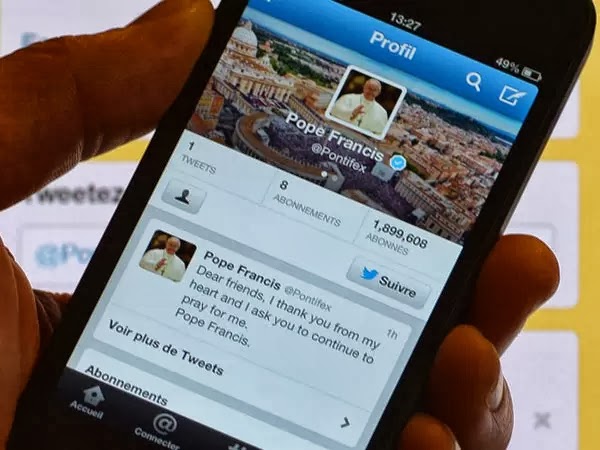
A man holds a smartphone showing Pope Francis’ first tweet in front of a computer screen showing the same tweet on March 17, 2013 in Rome. Jesus Christ was the world’s first tweeter because his pronouncements were “brief and full of meaning,” Vatican cardinal Gianfranco Ravasi said Wednesday, Sept. 25, 2013. AFP
The cardinal emphasized the importance of clergy making full use of modern-day computer technology.
 
“If a cleric, a pastor is not interested in communication, they are defying their duty,” he said.
The Vatican has stepped up its presence on the Internet in recent years, initially under Benedict XVI and now under Pope Francis, who has more than three million followers on Twitter in English alone.
 
Francis has also resorted to more traditional media, cold-calling ordinary faithful who have written to him and writing lengthy letters on religious issues that have appeared in the Italian press.

Facebook app tops Southeast Asia survey


MANILA, Philippines—Facebook, reportedly the world’s most successful social media platform, is the top ranking smartphone application (app) in Southeast Asia, according to a study released by Nielsen.
 
Based on the Southeast Asia Top 10 Smartphone Apps, Facebook was found to be the most engaging smartphone app in Indonesia, Malaysia and the Philippines, and was ranked No. 2 in Thailand behind the popular Japanese messaging app called LINE.
 
Other popular apps included Google Play Store, YouTube, LINE and Candy Crush Saga, all of which appeared on the top 10 rankings in all four markets in Southeast Asia.
The ranking was based on the Nielsen Informate Mobile Insights covering the Philippines, Malaysia, Indonesia and Thailand.
 
“The importance and influence of apps within today’s highly competitive mobile market has soared in recent years,” said Sagar Phadke of Nielsen’s Telecom and Technology Practice in Southeast Asia, North Asia and Pacific.
 
 
“Smartphone users in Asia are highly engaged in apps usage, and the app user base in Asia is growing rapidly, presenting huge opportunities for brand marketers to leverage apps to build lasting connections with consumers.”
 
In the Philippines, the Top 10 apps are (in order): Facebook, Google Play Store, YouTube, Candy Crush Saga, Viber, WeChat, LINE, Google Search, Skype and Facebook Messenger.
 
The Nielsen study also showed that smartphone owners in Southeast Asia spend around three-quarters of an hour on average per day using apps. Apps usage is most prevalent in Malaysia at 66 minutes per day, followed by Thailand at 46 minutes per day; the Philippines at 41 minutes; and Indonesia at 40 minutes

Tests: New iPhones less durable than iPhone 5


NEW YORK—As Apple pitches its newest smartphones, users may find something lacking compared with last year’s model: They could break more easily.
 
SquareTrade, a provider of protection plans for gadgets, tested five smartphones, including Apple’s new iPhones, to see if they could withstand drops, dunks and other common hazards. Its finding: The latest models aren’t as durable as last year’s iPhone 5.
 
The biggest loser, however, was Samsung’s Galaxy S4, which failed to work after being submerged in water and being dropped 5 feet (1.5 meters) off the ground, according to San Francisco-based SquareTrade.
 
The phone that withstood SquareTrade’s torture test best was Google Inc.’s Moto X. The Moto X is the first phone designed with the Internet company as Motorola’s new owner. Released in August, the Moto X is also the first smartphone assembled in the US.
 
“We were expecting that at least one of the new iPhone models would up its game, but surprisingly, it was the Moto X that proved most forgiving of accidents,” said Ty Shay, chief marketing officer at SquareTrade.
 

Customers check out the latest versions of the iPhone that went on sale Friday, Sept. 20, 2013, in Montreal. SquareTrade, a provider of protection plans for gadgets, tested five smartphones, including Apple’s new iPhones, to see if they could withstand drops, dunks and other common hazards. Its finding: The latest models aren’t as durable as last year’s iPhone 5. AP
Officials from Apple Inc., Samsung Electronics Co. and Google Inc. didn’t immediately return e-mail messages for comment.
Apple started selling two new iPhones on Friday. The iPhone 5S sports a fingerprint sensor, a better camera and a faster processor. A less expensive version, the iPhone 5C, offers consumers a wider choice of colors and has a better front-facing camera than the iPhone 5.
 
With every upgrade Apple has made, the latest model has usually been more durable than the previous one, based on drop tests SquareTrade has done over the past few years, Shay said. But that wasn’t the case this time.
 
SquareTrade reviewed each device based on eight factors, including the materials of the device’s front and back panels, its size and its weight. It also tested the device’s ability to withstand drops from 5 feet (1.5 meters) and being dunked in water for 10 seconds. SquareTrade says it uses robots to do the testing to ensure consistency.
 
SquareTrade rates phones on a scale of 1 to 10, with a higher number reflecting a higher risk of the device breaking. All five phones tested were considered to have a medium risk of breakage, but where they fell on the scale differed.
 
The Galaxy S4 scored 7, the worst of the five tested. The S4 ended up not functioning, with its screen coming half off, according to a video released by SquareTrade.
The iPhone 5S, made of aluminum and glass, scored 5.5, while the 5C, with a plastic housing, had a 6 rating. Both were worse than the 5 rating scored by the iPhone 5.
 
In particular, Shay noted that the iPhone 5C was more damaged when it was dropped than the iPhone 5. And the iPhone 5S also failed a slide test. It slid off of a table when it was pushed, unlike the other devices tested. By comparison, the iPhone 5C slid a little over 3 feet (90 centimeters), while the iPhone 5 slid just over 2 feet (60 centimeters).
 
The Moto X had a rating of 4.5, surviving the tests with only the slightest dent. Shay noted that the phone’s innovative rounded back molded to the shape of a user’s hand makes it easier for the consumer to grip.

Toshiba exec: TVs still relevant despite smartphones


SINGAPORE – A top executive of the Japanese electronics giant Toshiba believes that the television is still relevant amid the prevalence of smartphones, tablets and laptop computers.
 
While these gadgets let users watch videos, nothing beats the ability of a large-screen television to give an immersive viewing experience at home, said Shigenori Tokumitsu, president of Toshiba’s Digital Products and Services Company.
 
“We asked ourselves. What is the core value of TV? What to people expect from TV? If you just want to watch content or check information, you don’t need TV. A smartphone or tablet is enough for that. Then, why do people still need TV?” Tokumitsu said.
 
“TV brings us excitement – the larger the screen, the greater the excitement. We humans embrace excitement. Of course, today, you can watch movies everywhere – even on the small screen on your smartphone. However, when you are watching TV at home, you can get immersed in movies on a large screen, away from the real world. That is the entertainment power of TV,” he added.
 
Tokumitsu made the statement during the recently held Toshiba regional media conference in Singapore, where the company unveiled four “professional theater quality” televisions to respond to the demands of the Asian market.
 
Toshiba's Shigenori Tokumitsu (right) during the regional launch of the country's newest TV lineup
He noted how more Asian customers are shifting to large-size TVs similar to other regions, adding that 30% of the Asian market now prefers bigger screens compared to only 16% in 2010.
 
“Toshiba’s TV business is moving to a new phase in Asia and Middle East. We will strengthen our lineup with large screen sizes to meet an increase in demand,” he said.
The idea, Tokumitsu said, is to focus on screen size and image quality. While Toshiba’s newest offerings have Internet access and a slew of Android apps, their selling point is the ability to deliver movie theater quality into the living room.
 
“Toshiba always tries to make TV closer to the environment of a real movie theater,” he said, adding, “We bestow the name Pro Theater on this lineup because we believe it represents our ambition best, that is to deliver the maximum excitement and satisfaction for both viewers and visual professionals.”
 
With the new products, Toshiba is expecting to corner more than 20% of market share in unit terms in the region by the end of fiscal year 2013. The company has plenty of work to do in the Philippines, where Toshiba is more known for its computers instead of televisions.
“In the Philippines, our market share is only one digit,” Tokumitsu admitted. “First, we’d like to increase the market share at [a] two-digit [figure]. In order to do that, we’ll introduce not only the Pro Theater TVs, but also cost-competent products.”
 
The TVs
The four televisions launched during the Toshiba regional press conference include the L9300 series, the L4300 series, the L3300 series and the L2300 series. These are set to be available in the market within the month.
 
The L9300 series features four times the resolution of today’s 1080p full high-definition (HD) TVs as it is powered by Toshiba’s CEVO 4K and a quad-core CPU.
The L4300 series, on the other hand, is Toshiba’s first line of TVs with the Android operating system, letting users access apps and browse content. It also supports videos from YouTube.
 
The L3300 series features Toshiba’s image processing capabilities, letting viewers control image brightness and enhance resolution and image texture.
Meanwhile, the L2300 places emphasis on screen size.
Ronald So, assistant general manager of Toshiba’s Digital Products and Services Company, gives more insights on the company’s new TV lineup in the video below.

Scientists confirm Voyager 1 probe is in interstellar space


(Reuters) - Scientists have been debating for more than a year whether NASA's 36-year-old Voyager 1 spacecraft has left the solar system and become the first human-made object to reach interstellar space.
 

By a fluke measurement, they now know definitively it has.

"We made it," lead Voyager scientist Edward Stone, from the California Institute of Technology, told reporters on Thursday.

The key piece of evidence came by chance when a pair of solar flares blasted charged particles in Voyager's direction in 2011 and 2012. It took a year for the particles to reach the spacecraft, providing information that could be used to determine how dense the plasma was in Voyager's location.

Plasma consists of charged particles and is more prevalent in the extreme cold of interstellar space than in the hot bubble of solar wind that permeates the solar system.

Voyager 1, now 13 billion miles (21 billion km) from Earth, could not make the measurement directly because its plasma detector stopped working more than 30 years ago.

"This was basically a lucky gift from the sun," Stone said.

Extrapolating from the measurements, scientists believe Voyager actually left the solar system in August 2012. That summer, the spacecraft radioed back another tantalizing piece of information, showing a huge spike in the number of galactic cosmic rays from outside the solar system and a corresponding decrease in particles emanating from the sun.

Scientists had been reluctant to conclude last year that Voyager had reached interstellar space because it was still picking up magnetic field measurements that were very similar to the sun's magnetic field.

Computer models had predicted a significant shift in the interstellar magnetic field's alignment.

"The magnetic field is still something that puzzles us considerably," said physicist Gary Zank, with the University of Alabama in Huntsville.

Scientists now believe the interstellar magnetic field is somehow draped around and twisted by the heliosphere, the bubble of space under the sun's influence.

Understanding how that happens is just one of the questions the Voyager team will attempt to figure out while the probe still has power. Voyager 1, and a sister spacecraft Voyager 2, use heat released by the natural decay of radioactive plutonium to generate electrical power for their instruments.

'TRULY ALIEN ENVIRONMENT'

After 2020, scientists expect they will have to start turning off instruments, until around 2025 when the probes will be completely out of power and fall silent.

Voyager 2, which is heading out of the solar system in another direction, has five to seven more years before it reaches interstellar space, said Donald Gurnett, a longtime Voyager scientist at the University of Iowa.

"We're in a truly alien environment," Zank said. "What Voyager is going to discover truly beggars the imagination."

The two Voyager probes, which were both launched in 1977 to study the outer planets of the solar system, contain gold phonographic records etched with music, greetings, sounds and images from Earth. The project was spearheaded by astronomer Carl Sagan, who died in 1996.

With Voyager 1 having left the solar system, the next time it will encounter a star is in 40,000 years, when it flies about 1.7 light years away from a star in the constellation Camelopardalis called AC +79 3888. The spacecraft is traveling nearly 1 million miles (1.6 million km) a day.

"Voyager has once again joined the ranks of the great human journeys of exploration," Gurnett said. "This is the first journey into interstellar space."

NASA's twin Pioneer spacecraft, launched in the 1970s, also are leaving the solar system, but they have run out of power to relay information back to Earth.

The research is published in this week's journal Science.

Apple unveils two new iPhones, starting at $99


CUPERTINO, California—Apple unveiled two new iPhones on Tuesday in its bid to expand its share of the smartphone market, including one as low as $99 with a US carrier contract.
 
“The business has become so large that this year we are going to replace the iPhone 5 and we are going to replace it with two new designs,” Apple chief Tim Cook announced at the company’s Silicon Valley headquarters.


Craig Federighi, senior vice president of Software Engineering at Apple, speaks during the new product release in Cupertino, Calif., Tuesday, Sept. 10, 2013. AP PHOTO/MARCIO JOSE SANCHEZ
The top-line iPhone 5S “is the most forward thinking phone we have ever created,” said Apple vice president Phil Schiller.
 
“It is the gold standard in smartphones.”
Apple also broadened its color palette, announcing the low-cost phone in blue white, pink yellow and green, and the top-line model in silver, gold and a new “space gray.”


Cook calls it “more fun and colorful” than any other iPhone. The 5C has a 4-inch (10-centimeter) Retina display and is powered by Apple’s A6 chip. It also has an 8 megapixel camera, live photo filters and a rear cover that lights up.
 
The iPhone 5C with 16 gigabytes of memory will sell for as low as $99 with a US carrier contract, half the cost of earlier iPhone base models. The 32 gigabyte model  will sell for $199 with a two-year wireless contract.
 
Analysts were keenly focused on the promise of an iPhone 5C to win over buyers in China and other developing markets where there is fierce competition from low-priced smartphones powered by Google’s Android operating system.


Pope Francis ‘selfie’ goes viral on social media


VATICAN CITY — Pope Francis has broken protocol once again, appearing with a puzzled look on his face in a “selfie” photo taken with a group of teenagers visiting the Vatican.
 
The picture appeared on the Facebook page of one of the youngsters, who used it as his profile picture, and was going viral on social media on Saturday.
 
The picture comes in the same week that the Oxford English Dictionary included the word “selfie” to denote a self-taken photograph on a smartphone.
 
In this Aug. 28, 2013 file photo provided Thursday, Aug. 29, 2013 by the Vatican newspaper L’Osservatore Romano, Pope Francis has his picture taken inside St. Peter’s Basilica with youths from the Italian Diocese of Piacenza and Bobbio who came to Rome for a pilgrimage, at the Vatican. The pontiff had a private audience with 500 youths from the diocese. AP


The young believers were part of a church group from northern Italy who met with the leader of the world’s 1.2 billion Catholics on Wednesday and were seen going up to him afterwards to take their photo.
 
“There is no marketing behind these actions. The pope clearly likes being with people while his predecessor liked being with books,” said Beppe Severgnini, columnist for the Corriere della Sera daily.
 
The 76-year-old pope, Latin America’s first pontiff, has repeatedly broken with Vatican tradition since being elected in March, including regularly picking up the phone and calling ordinary people who write to him.
 
The photo prompted bemused reactions on Twitter, with one user saying “Now I’ve seen everything” and another quipping: “It’s the end of the world as we know it.”
One unenthused tweeter commented: “Just because Pope Francis poses for a ‘selfie’, doesn’t make it okay!”